Introduction
The v for vendetta mask is one of the most recognizable symbols in modern culture. Whether seen at protests, online forums, or in artwork, it carries a presence that feels both historical and contemporary. Its meaning didn’t appear out of nowhere; the mask was shaped by centuries of political memory, a graphic novel that reframed its symbolism, and a film that pushed it into global pop culture. Today it stands as a statement about resistance, identity, and the power of ordinary individuals. Its resonance isn’t because of a trend, but because its story continues to align with the feelings of people facing systems they believe are unjust.
Origins of the Mask
Long before the v for vendetta mask ever appeared in a comic or movie, the face behind it belonged to Guy Fawkes, a member of a group of English Catholics involved in the 1605 Gunpowder Plot. Their goal was to blow up the House of Lords and challenge what they believed to be oppressive rule. Fawkes was discovered guarding barrels of gunpowder beneath Parliament, arrested, and later executed. Although the plot failed, his story became part of British cultural history.
For centuries after, November 5th—known as Bonfire Night—was commemorated with effigies of Fawkes and public celebrations. His image shifted between villain, rebel, and cultural figure depending on the era. Historians such as Antonia Fraser have written extensively about how Fawkes became a symbol that people projected different meanings onto. This shifting identity made him fertile ground for reinterpretation, which happened in a dramatic way centuries later.
The Mask in V for Vendetta
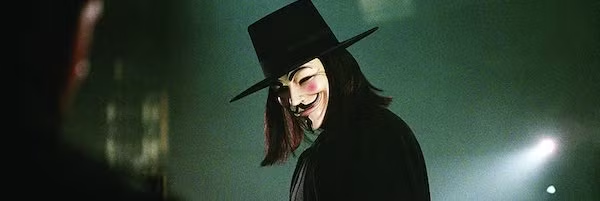
The v for vendetta mask as we know it today emerges directly from the graphic novel V for Vendetta, written by Alan Moore and illustrated by David Lloyd in the 1980s. Lloyd designed the stylized Guy Fawkes face, believing it created a visual presence that felt mysterious, rebellious, and timeless. In the story, the character V uses the mask not only as a disguise but as a statement—an embodiment of resistance against a totalitarian government.
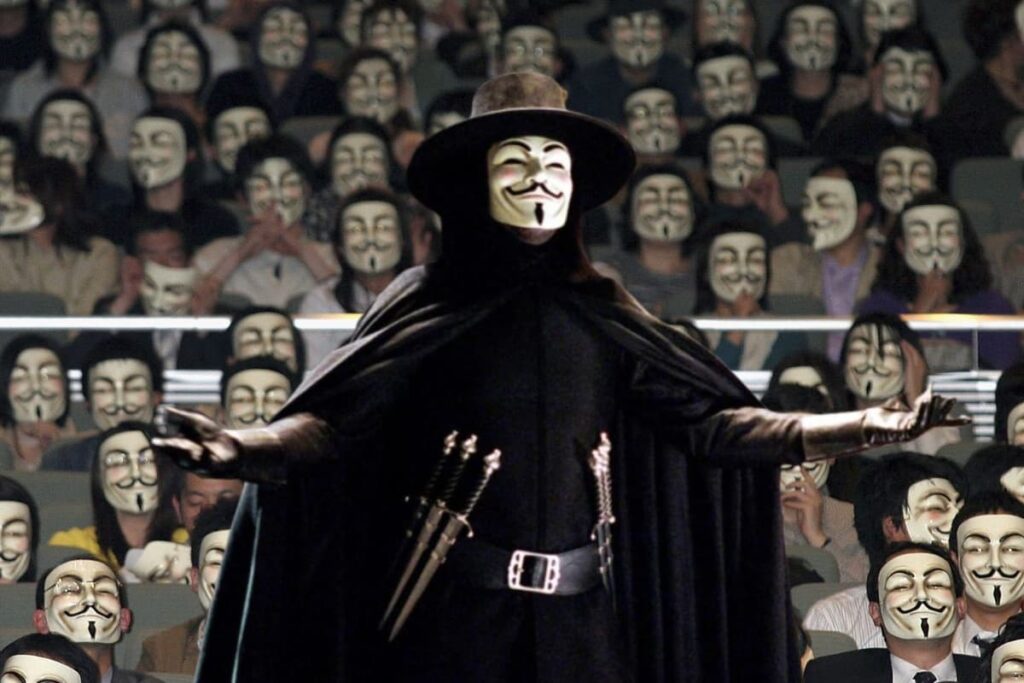
Moore’s writing drew heavily from real-world political themes: censorship, authoritarian rule, and the power of individual defiance. The graphic novel took a historical figure and reframed him as a metaphor for challenging oppressive systems. When the 2005 film adaptation was released, the mask’s popularity exploded. The film brought the mask far beyond comic circles and into mainstream culture. Its memorable scenes, especially those showing crowds of masked citizens reclaiming their power, created an image that stuck with audiences.
The film’s release coincided with a digital age where movements spread more quickly, and imagery carried new strength. The mask became more than a movie prop; it became a global symbol people adopted for their own reasons.
Transformation Into a Modern Icon
The v for vendetta mask gained a new dimension when online communities and grassroots movements embraced it as a sign of unified dissent. The collective Anonymous, initially emerging from internet forums, adopted the mask during the mid-2000s. This choice wasn’t random. The mask offered anonymity while projecting a message of solidarity and resistance. When Anonymous began participating in protests and online activism, the mask turned into a recognizable emblem of digital-era rebellion.
From there, it spread across various political movements around the world. During the Arab Spring, Occupy Wall Street, anti-corruption marches, and demonstrations against government overreach, people wore the mask to express their frustrations. It acted as a unifying face—not tied to a single political party or ideology, but to the broader idea of standing against oppressive power.
The symbolism resonated because it was adaptable. People could wear the mask for different causes while still tapping into its core message: the right to challenge unfairness. Its presence at international protests showed that the mask was no longer a niche pop-culture item but a universal expression of dissent.
What the Mask Represents Today
The enduring power of the v for vendetta mask lies in its layered meaning. It represents anonymity, not as avoidance, but as collective action. When many people wear the same mask, individual identity blends into a shared cause. This makes the mask especially attractive to groups who fear retaliation or censorship.
It also symbolizes the refusal to stay silent. The smile on the mask, paired with its sharp mustache and pointed features, gives it a confident—almost defiant—expression. It visually signals boldness. People wear it because it allows them to embody courage even if they feel personally vulnerable. The mask becomes a shield, but also a voice.
Another powerful element is its connection to anti-corruption and anti-authoritarian sentiment. Historically inspired by a failed rebellion, reshaped by literature, and spread through film, the mask carries a narrative that resonates across generations. In a time when political frustration, digital surveillance, and social inequality remain global issues, the mask feels relevant rather than outdated.
Its symbolism is not defined by a single group or historical event. Instead, it reflects an ongoing desire for transparency, fairness, and freedom. Whether worn at a protest or used as an icon online, it continues to express the feeling that ordinary people deserve a say in how they are governed.
Cultural Impact and Lasting Relevance
The cultural presence of the v for vendetta mask has expanded far beyond its origins. It has appeared in artwork, documentaries, protest footage, and social media. It is often seen in news coverage when public dissatisfaction reaches a boiling point. The mask has become shorthand for the idea that people are stronger when united, and that symbols can help articulate values that words alone sometimes struggle to capture.
Its presence in digital spaces is especially notable. Online activism and decentralized communities have grown significantly, and the mask has become part of that environment. Users adopt it in profile pictures, videos, or creative projects to display their alignment with ideas of resistance and transparency.
The mask’s lasting relevance also reflects how visual symbols operate in modern society. Images today spread faster than speeches, and symbols carry emotional impact. The v for vendetta mask has the advantage of being instantly recognizable while carrying a story that supports its use. Because the mask’s meaning has evolved naturally rather than being engineered for marketing, people trust its authenticity.
Criticisms and Misinterpretations
As with any powerful symbol, the v for vendetta mask has faced criticism. Some argue that its widespread commercial production contradicts its anti-establishment message. The fact that masks are often sold by major corporations has sparked debate about the relationship between activism and consumerism. The symbol of rebellion being bought from the very structures it critiques creates an uncomfortable paradox for some.
Others believe the mask’s meaning can become diluted when used without understanding its history. When protesters or online groups adopt it casually, critics suggest that the symbol risks becoming an aesthetic rather than a statement. There is also the challenge of misinterpretation—different groups may use the mask for conflicting ideologies, which can complicate public perception.
Despite these criticisms, most agree that symbols evolve according to how they are used. The mask’s flexibility is part of its strength. Even when its meaning is debated, that debate proves its cultural significance.
Why It Still Resonates
The enduring appeal of the v for vendetta mask lies in its timeless themes. People across generations relate to the struggle for fairness, the desire for transparency, and the fear of being silenced. The mask encapsulates these emotions without locking itself into a single political narrative.
Its visual design contributes to its power. The confident smile, the exaggerated features, and the historical references combine to create an image that feels both rooted in the past and relevant to the present. It conveys courage and individuality while reminding people that they are part of something larger.
The mask also resonates because it leaves room for interpretation. Someone wearing it to protest corruption in one country may not share the exact same goals as someone wearing it during a digital rights march in another. Yet both recognize the mask as a representation of resistance. It bridges cultural and geographic divides because its message is fundamentally about human dignity and empowerment.
Finally, the mask remains influential because it connects storytelling with social action. Its meaning grows out of history, literature, and film—three forces that shape how societies understand themselves. When people wear the mask, they tap into that narrative, blending personal beliefs with a symbol that has already crossed many boundaries.
Conclusion
The v for vendetta mask carries a unique legacy shaped by history, fiction, and real-world activism. From Guy Fawkes and the Gunpowder Plot to Alan Moore’s graphic novel and the global protest movements of the 21st century, its meaning has expanded far beyond its origins. Today it stands as a powerful emblem of courage, unity, and the refusal to accept injustice without challenge.
Its lasting resonance comes from its ability to evolve with society. It speaks to personal freedom, collective identity, and the belief that ordinary people can make a difference. The mask’s journey from a historical figure to a global symbol shows how ideas continue to transform—and how powerful imagery can inspire action long after the story begins.
If you’d like, I can also help create meta descriptions, tags, or a short excerpt for your blog post.
FAQ
1. Why is the V for Vendetta mask so popular?
The mask blends historical meaning with modern symbolism, making it a recognizable sign of resistance, anonymity, and collective action.
2. What does the mask represent in today’s culture?
It reflects themes of anti‑corruption, freedom of expression, and standing against oppressive systems, both online and in public movements.
3. Is the V for Vendetta mask directly connected to Guy Fawkes?
Yes. The mask is inspired by Guy Fawkes’ image, but its modern meaning comes mainly from the graphic novel and film adaptation.
4. Why do people wear the mask at protests?
Protesters use it to protect their identity while signaling unity, courage, and shared purpose during demonstrations.
5. Has the meaning of the mask changed over time?
Its meaning has expanded, evolving from a historical reference to a global symbol of defiance and personal empowerment.